5 Small Shifts I’m Making to Nourish My Brain
I have a wonderful accountability partner who often helps me see life from a different angle.
She is a mirror for me - not in the sense of telling me what I should do, but in reflecting back possibilities for how I might live a more thriving life. Through our rich conversations, our curiosity, and the way we challenge and encourage one another, I genuinely believe I am a better human because of our connection.
Recently, one of those conversations was about food.
My friend has been on a carefully monitored journey with a ketogenic diet. She recently attended an online conference through Harvard Medical School and came away completely lit up by what she had learned about the relationship between metabolism, nutrition, and brain health.
For her, it felt deeply affirming.
She had already experienced changes in how her own brain and body felt while following this way of eating. Now she was hearing researchers and physicians explore some of the science behind the relationship between food, metabolism, and mental health.
Her excitement was contagious.
And yet, my response wasn't:
“Okay, I'm going keto tomorrow.”
I've lived long enough to know myself better than that.
I’ve Been Down the Diet Road Before
In my 30s and 40s, I feel like I yo-yoed my way through so many of the eating trends of the moment.
Paleo. The Zone. And probably a few others I've conveniently forgotten.
There was always another plan. Another set of rules. Another promise that this was the way I should eat.
What I've learned about myself since then is something much simpler:
Micro steps stick.
I'm no longer interested in chasing dietary perfection. I'm interested in overall wellbeing.
I want to feel strong. I want energy. I want to protect the health of my brain and body as I age. And I want the way I eat to feel nourishing rather than punishing.
There is another reason this subject touches me deeply.
My sister has suffered greatly from a severe mental health condition.
I would never pretend that changing what we eat is a simple answer to something so complex. But learning more about nutrition and brain health has made me think differently about something I can do when I visit her:
I can nourish her.
I can prepare beautiful, wholesome food. I can sit at a table with her. I can offer care through something as ordinary and human as a meal.
Maybe food doesn't have to be another thing we control.
Maybe it can be one of the ways we care.
And so, instead of embarking on another “diet,” I'm experimenting with five small changes.
1. Add Before I Subtract
This may be the biggest change in my thinking.
Instead of beginning with everything I shouldn't eat, I'm asking:
What can I add that will nourish me?
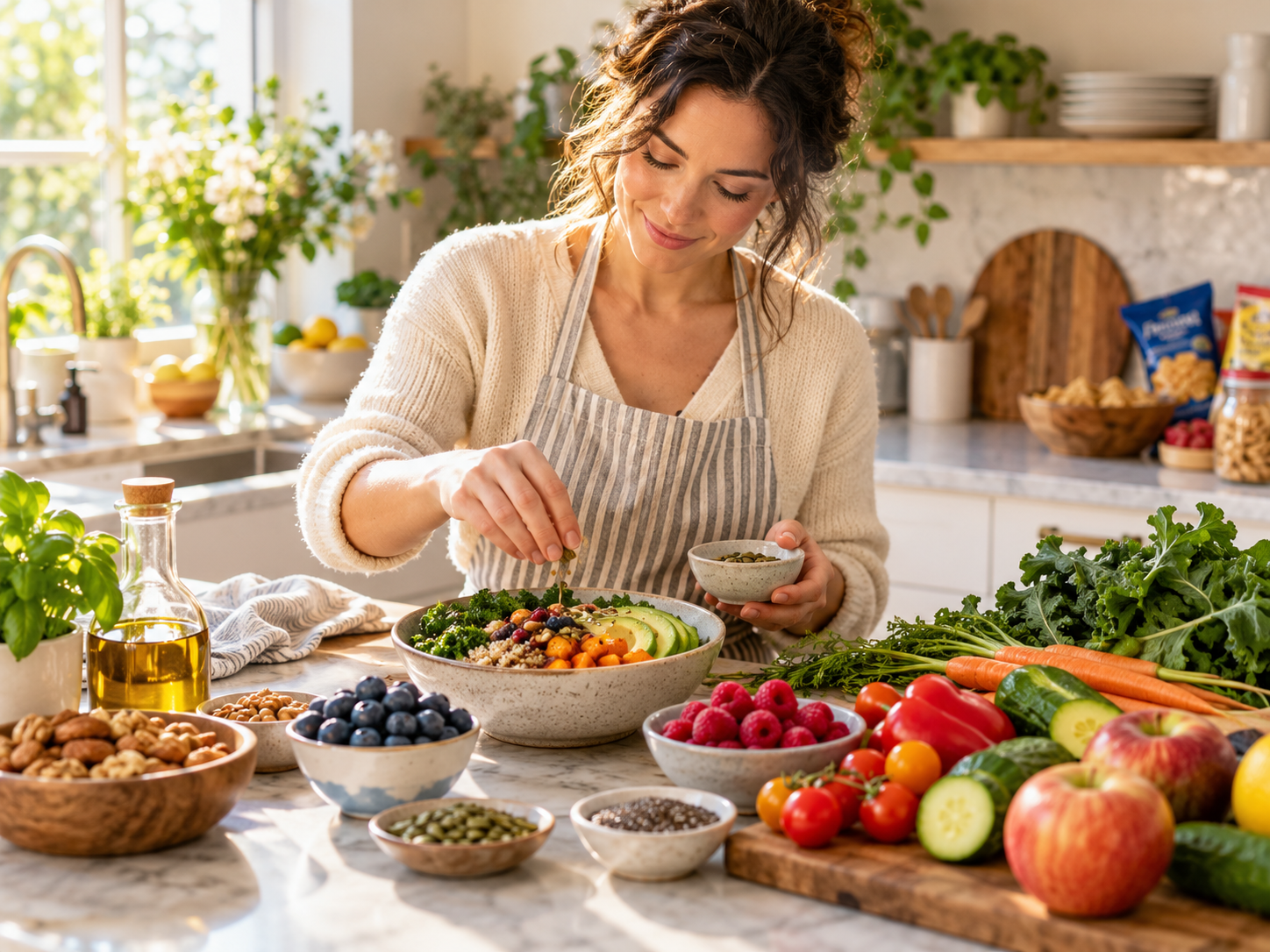
More colorful vegetables. More whole foods. Nuts and seeds. Quality proteins. Berries. Olive oil. Foods that actually look like something that grew in the earth or came from nature.
There is something gentler about addition.
If I fill my plate with foods that nourish me, perhaps some of the things that don't serve me will naturally become less important.
No dramatic pantry purge required.
2. Eat Less Food That Comes From a Factory
One area of brain-health research that caught my attention is the growing interest in ultra-processed foods and mental wellbeing.
That doesn't mean I'm declaring packaged food “bad.”
I don't want another food rule.
Instead, I'm becoming more curious.
Could I choose an apple and a handful of nuts sometimes instead of something packaged? Could I make a simple dinner from recognizable ingredients rather than reaching for something heavily processed? Could I notice how different foods make me feel afterward?
I'm interested in replacing judgment with awareness.
3. Borrow From the Mediterranean Table
Of all the approaches I've been reading about, the Mediterranean way of eating feels wonderfully abundant.
Vegetables. Beans. Lentils. Nuts. Seeds. Whole grains. Fish. Olive oil. Fruit.
It doesn't immediately strike me as a “diet.”
It feels like food.
Research into Mediterranean-style dietary interventions has also produced some encouraging findings around mental health, although nutrition is certainly not a replacement for appropriate mental healthcare.
For me, the takeaway isn't that I need to become perfectly Mediterranean.
It's that I can borrow from the table.
A little more olive oil.
Another vegetable.
Fish instead of my usual choice.
Beans tossed into a salad.
Small things.

4. Become Curious About My Gut
I'm also fascinated by the conversation around the gut-brain connection.
Our digestive system and brain are in constant communication, and researchers continue to investigate the many ways our gut microbiome, metabolism, immune system, and brain may interact.
Again, I'm resisting the urge to turn this into another complicated project.
I don't need a cupboard filled with expensive powders promising to “fix” my microbiome.
Maybe my first experiment is simply diversity.
More plants. More fiber-rich whole foods. Perhaps fermented foods that I enjoy and tolerate.
And then notice.
How do I feel?
How is my energy?
How is my digestion?
How clear does my brain feel?
Curiosity instead of rigidity.
5. Explore Ketosis Without Making It My Next Identity
This is probably the area I'm most curious about because of my friend's experience.
Researchers are studying ketogenic diets in relation to brain metabolism and several neurological and psychiatric conditions. There are intriguing findings, but there is also much we still don't know.
And a medically supervised ketogenic diet used therapeutically is very different from casually deciding to “go keto” because it's trending online.
So I'm not rushing toward an extreme.
I'm listening.
I'm learning.
I'm watching my friend's journey and asking questions.
And if I decide to explore meaningful carbohydrate restriction or ketosis, particularly for a health reason, I want to do it thoughtfully and with appropriate professional guidance.
Because perhaps the biggest lesson I've learned from all my years of trying different ways of eating is this:
I don't need another revolution.
I need practices I can live with.

Food as an Act of Care
I'm beginning to see this exploration as being about something much bigger than food.
It's about how I want to age.
How I want to feel.
How I care for my brain.
How I care for the people I love.
And perhaps even how I sit at a table with my sister.
There is so much about mental illness that I cannot fix for someone I love. I know that deeply.
But I can arrive with groceries.
I can chop vegetables.
I can make something delicious.
I can sit beside her and share it.
And I can continue learning how to nourish my own brain and body, not from fear, and not because I'm chasing the next diet, but because I want to live this chapter of my life with intention.
So these are my five micro steps.
Not a diet.
Not a 30-day challenge.
Not a promise to be perfect.
Just five small ways I'm becoming more mindful about what I put on my plate.
Because I've learned that the changes that transform my life are rarely the dramatic ones.
They're the little ones I can actually keep.
This article reflects my personal exploration and is for educational purposes, not medical advice. Nutrition can be one component of health and wellbeing, but dietary changes should not replace appropriate mental health or medical treatment. Therapeutic ketogenic diets in particular should be explored with qualified healthcare professionals.
Jennifer Degen, MA
October 9, 2026
Categories
Select Category...
- Alberto Villoldo
- Ancestral Superfoods
- Art
- Attunement
- Autumn wellness retreat
- Body
- Boundaries
- Breathwork
- Buddhist Tradition
- Burnout
- Chanting
- Community
- Community Engagement
- Contentment
- Costa Rica
- Costa Rica Retreat
- Creative Expression
- Creativity
- Crystal Healing
- Daily
- Deep Rest
- Diet
- Digestive Health
- Embodied Living
- Family & Wellness
- Festival Reflections
- Financial security
- Food
- Gratitude
- Grief Transformation
- Grounding
- Guided Meditation
- Habit Patterns
- Hakomi therapy
- Hatha
- Healing
- Health
- Health & Wellbeing
- Health Wellness
- Healthy Diet
- Heated Yoga
- Holiday Event
- Hypnosis
- Hypnotherapy
- Intelligence
- Intention
- Intuition
- Judgement
- Kathleen Burns Kingsbury
- Kundalini
Featured Blogs